God and the Art of Toy and Diecast
Marketing
Something is Awry with the Timeline (part 4)
By L. S. Su
What is currently being taught
in public institutions today is that mankind is roughly 80,000
years old and some creature (not defined human or homo sapiens)
who also walked upright was around millions of years before
humans. Since I believe by faith that the Bible is both true
and accurate and since I also believe the creation story in
Genesis is an eye-witness account by the author of all life,
I am able to conclude something is definitely awry with academia's
timeline.
I certainly can understand that
the majority of the people on Earth do not accept the Bible's
claims as an axiom. According to Merriam-Webster, an axiom is
a statement or proposition that is regarded as being established,
accepted, or self-evidently true. But here's the thing, we all
need faith in certain assumptions to be true. And not all assumptions
are wild guesses. If you do not accept certain axioms, you cannot
make any kind of conclusion -this includes a timeline for mankind.
If you reject that the Bible is true, then I can certainly see
how it would be much easier to accept that space aliens brought
DNA spores here to Earth, that man evolved from sea sponges,
jelly fish, or maybe even rocks.
One characteristic about the timeline
for mankind is a beginning point. The Bible clearly teaches
that man was created. By default that means there must be a
Creator. The study of the "beginnings" is more of
a theological study than a scientific study. When studying the
origin of mankind, the starting point needs to be revealed not
inferred. For example, if I were to ask you, "What was
your father's great great grandmother's name?"
I think we would all be in agreement
that she exist on Earth; but some PERSON revealing the answer
to you and you in turn placing your faith in what that person
is a far better way to obtain the answer than studying items
in your environment. But no matter which way you attempt to
answer to this question, at some point you need to place your
faith that something is true.
In my opinion, studying the Godhead
is the ultimate study of studies. It is the ultimate philosophical
study and the branch we call science is just one small branch
off the the ultimate philosophical study. Good science is a
good in the fact that it should provide glimpses that your theology
is correct -mainly because both are rooted in reality. But keep
in mind that science can only answer a small subset of all the
questions out there. The ultimate philosophical study answers
very deep questions like origin, meaning (purpose), morality
(right and wrong), or destiny. The branch we call science doesn't
answer any of these deep question humans have.
You would be hard pressed to use
physics, biology, chemistry, and mathematics to answer a question
like, "Why is it wrong to commit murder?" or "Do
humans have souls?" or "If so, what is the destiny
of a soul?" Whether you believe that the first man was
created or evolved, I think we're in agreement that there had
to be a first human man. In my opinion science is also a totally
inadequate tool to answer who was the first man to walk this
Earth?
I think to use science to the infer
the origin of man is a kin to using botany (the study of plants)
to explain why fruit falls to the Earth. It's just an inadequate
tool to use to arrive at a meaningful explanation. However,
there is some really good news. It actually ties into the meaning
of Christmas. The Bible does reveal who the first man was AND
provides his genealogy; and thus a timeline for mankind can
be reconstructed. The Bible reveals the blood lines from Adam
(who it claims to be the first man) to the incarnation (i.e.
what Christmas is all about.....God becoming a man). As pointed
out in a previous article, one of the books in the Bible (Luke
3: 24 - 38), reveals to us the lineage from Adam to Jesus Christ.
From my observation, and I could
be wrong on this, but the timeline that academia is teaching
today is based on a single tool called radiometric dating. You
should realize that radiometric dating is not a mutually exclusive
tool (i.e. either you have faith in the Bible or faith in radiometric
dating). Radiometric dating is a tool that is available to all
scientists -no matter their color, sexual orientation or whether
they accept or reject the Bible. If both the Bible and radiometric
dating are accurate tools to study the origins of man, then
I feel it's better to have two tools to use to reconstruct the
timeline than just one. Now since academia is only using one
tool (radiometric dating) to reconstruct the timeline for life
on Earth, I think it's important that you sort of understand
how it works and the axioms behind it.
Carbon dating is one type radiometric
dating that most of us are probably somewhat familiar with.
It's often used to measure the age of something that was living
before (e.g. tree, animal, a Furby), Since things like rocks
were never living to begin with (unless those rock-like creatures
in the latest Noah movie were real), you cannot use carbon dating
to date the age of rocks, but need to use some other element
like potassium or uranium. For you to accept that radiometric
dating is an excellent tool to measure the age of objects, you
accept by faith these four assumptions (axioms).
1) Half life of radio active elements
are known or can be calculated accurately.
2) Radioactive elements breakdown (decay) at a steady known
rate.
3 ) You are able to know the starting levels of how much radioactive
material that object originally possessed.
4 ) The object being dated was not exposed to something that
could affect its decay rate.
I know it's been a long time since
you went over how carbon dating works and heard words like "half-life"
(unless you are hip to video games). But in a nut shell the
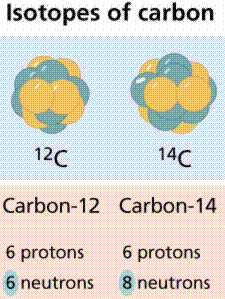
way carbon dating works is that organic life absorbs carbon-14
while its alive via air, water, and food that it takes in. When
it dies, it stops absorbing carbon-14 (another axiom). Carbon-14
(unstable) is radioactive and as it decays, it become carbon-12
(stable) by shedding two neutrons. Since the rate of decay is
constant (an axiom), scientists have special equipment that
allows them to measure the remaining amount of carbon-14 left
in that object that was formally alive. They can then make a
conclusion of how old organic objects are and then re-construct
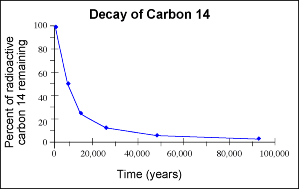
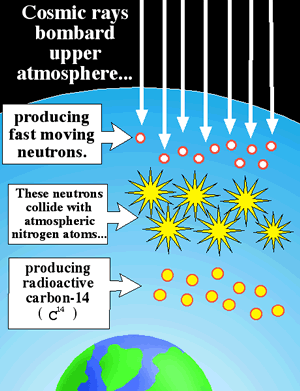
a timeline. Here are some pictures to help you sort of absorb
this process.
Academia teaches that the half
life of carbon-14 is 5730 years. Since the half life of carbon-14
is considered relatively short and cannot be used to measure
the age of something that is millions of years old, scientists
need to use other elements with longer half-lives -like potassium.
Academia teaches that potassium has a half life of 1.248 x 10
to the 9th power. In other words the half life of potassium
is 1,248,000,000 years. So after one half life, the amount of
radioactive carbon-14 or potassium the object posses will be
exactly half of what it use to have. So for radiometric dating
to work correctly, you must accept by faith points #1 and #2
above are true. One thing you must realize is that you cannot
use "science" to prove #2,
Merriam-Webster defines science
as: knowledge or a system of knowledge covering general truths
or the operation of general laws especially as obtained and
tested through the scientific method and concerned with the
physical world and its phenomena. So at this time no human can
through the scientific method (hypothesis, test, and observe)
that the half life of carbon-14 (C14) is 5730 years or demonstrate
that in two-half-lives (11,460 years) the amount of carbon-14
an object has will be exactly half of what it used to have 5730
years ago. Showing me that the half life of potassium is true
is a slightly more difficult feat.
Scientist by faith accept that
by testing radioactive isotopes with much shorter half-lives
(days, weeks, months) and plotting their rate of decay that
elements with much longer half-lives behave the same way. Even
though we are unable to reproduce the same conditions in a lab
that a fossil experienced, we take by faith that no outside
influence can affect the rate of radioactive decay (e.g. water).
It is by faith that we accept the half life theory for radioactive
elements is an accurate. I would also like to point out that
it is my faith that we accept that Abraham (roughly half way
up the Biblical lineage time line from Adam to Jesus) really
existed and had a son named Isaac.
But for radiometric dating to be
a useful tool, you need all four (4) assumptions above to be
true. If any of them fail, then this would put into question
the accuracy of using radiometric dating to date objects. In
turn this would put into question whether the timeline academia
is advertising is accurate. I personally accept by faith #1
and #2 are accurate. It's #3 and #4 that I have a problem with.
One axiom that I know academia
accepts and just glosses over (at least at the high school level)
is the starting levels of carbon-14 is a known number. I think
we should be in agreement that the starting levels is a vital
piece of information in order for radiometric dating to be accurate
right? How is carbon-14 created in the first place? It's only
created in Earth's upper atmosphere (we believe). Academia makes
the assumption that the carbon-14 rate of creation today is
the same thousands or millions of years ago. Furthermore academia
also makes the the assumption that the absorption rate if carbon-14
is the same for all organic life (e.g. trees, plants, humans,
and sea creatures) There are a few observations you can make
now that allows you to conclude the Earth's atmosphere was very
different than it is today.
The Bible gives us a clue that
the Earth's atmosphere behaved very differently than it does
today.
This is the account of the heavens
and the earth when they were created, when the Lord God made
the earth and the heavens.
Now no shrub had yet appeared on the earth and no plant had
yet sprung up, for the Lord God had not sent rain on the earth
and there was no one to work the ground, but streams came
up from the earth and watered the whole surface of the ground.
-Genesis 2: 5, 6
It didn't rain? I guess that's
a good thing because the umbrella probably wasn't invented back
then. That's a very different phenomenon going on Earth's lower
atmosphere, if there didn't rain. That would suggest to me that
water didn't evaporate. That would suggest to me the air was
super humid as oppose to dry. Moreover, the climate must have
been much warmer than it was today for people to up and about
without the need to don jackets that say The North Face.
Adam and his wife were both naked,
and they felt no shame. -Genesis 2:25
Another clue the Bible gives us
that it didn't rain during the pre-flood Earth was the sign
of the rainbow. You need water particles in the air and sunlight
to produce a rainbow. The Bible teaches this prism effect of
sunlight and water particles was a brand new thing for people
to observe post flood.
Then God said to Noah and to
his sons with him: “I now establish my covenant with
you and with your descendants after you and with every living
creature that was with you—the birds, the livestock
and all the wild animals, all those that came out of the ark
with you—every living creature on earth. I establish
my covenant with you: Never again will all life be destroyed
by the waters of a flood; never again will there be a flood
to destroy the earth.” -Genesis 9: 8 - 11
A covenant is a promise sealed
with a symbol.
And God said, “This is
the sign of the covenant I am making between me and you and
every living creature with you, a covenant for all generations
to come: I have set my rainbow in the clouds, and it will
be the sign of the covenant between me and the earth. Whenever
I bring clouds over the earth and the rainbow appears in the
clouds, I will remember my covenant between me and you and
all living creatures of every kind. Never again will the waters
become a flood to destroy all life. Whenever the rainbow appears
in the clouds, I will see it and remember the everlasting
covenant between God and all living creatures of every kind
on the earth.” -Genesis 9: 12 - 17
But even if you don't believe the
Bible, when you look at the archeological evidence that these
very large animals roamed the Earth at one time, the land must
have been much more tropical like. The Earth at one time must
have been more lush with vegetation in order to support these
very large creatures, which we only started calling them "dinosaurs"
in 1842. So it's reasonable that the Bible doesn't use this
word to describe these very large animals. I think it's also
reasonable to conclude that the climate was very different pre-flood,
because a Brachiosaurus could not survive a single Winter in
Colorado or other parts of the world where they have unearthing
their fossils now.
Now for carbon dating to be accurate,
scientists make the assumption (i.e. accept axiom #3) that the
production rate of C14 in the upper atmosphere and the absorption
rate of C14 was the same back then as it is today. But we seem
to have two different types of Earth pre and post flood. And
I think the Bible gives us a clue that the upper atmosphere
was different too. The hint is in these words spoken by God:
Then the Lord said, “My
Spirit will not contend with humans forever, for they are
mortal; their days will be a hundred and twenty years.”
-Genesis 6:3
Wouldn't it had been easier to
just round down and say "one hundred years?" These
words were spoken right before the flood. These words were prophetic
and were not fulfilled immediately; because people post flood
(e.g. Noah, Abraham, Moses) lived far longer than 120 years.
But God's words spoken way back then have now reach fulfillment
today -at least I'm not aquatinted with anyone that has lived
past 120 years on Earth.
Why do we now only get to live
less than 120 years in these current bodies that we have now?
When Abraham's wife was around 90 years old, she was still a
good looking woman -good enough to be added to a king's harem.
I don't think that happen too often these days. So what's causing
us to age so quickly now?
You ever see some older people
who when in their youth they spent much time in the sun? Their
skin seems to have aged more quickly than those who didn't sunbathe.
I think the answer is radiation. When I say radiation, I'm talking
about electromagnetic radiation on the high end of the spectrum
(i.e. x-ray, cosmic, gamma). Stuff that comes from outer space
and penetrates right through your house and right through you.
While these high speed particles zip through you, it damages
cells and even your DNA. What protects us from most but not
all of this harmful electromagnetic radiation?
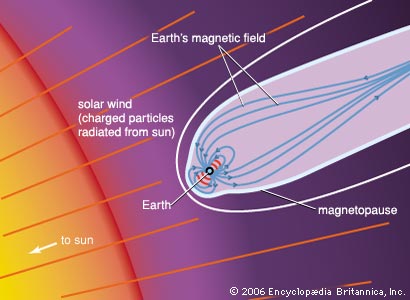
The answer isn't sun block or wearing
one of those black Islamic burqas. The answer is something above
the upper atmosphere. The answer is the Earth's magnetic field.
It's pretty amazing stuff -It's as if this Earth was specially
designed for mankind. Not only do we need a planet with a lot
of water, the planet needs to be the proper distance from a
star. Too close and all the water vaporizes off the planet;
Too far, and it's all ice. But the third thing we need is a
planet that has a molten core that produces a very strong magnetic
North and South pole. The stronger the magnetic field, the more
this field is able to repulse harmful radiation away from even
entering the Earth's atmosphere. My theory is that the less
harmful radiation we are exposed to, the longer and healthier
lives we can live.
God ordained that man would not
live past 120 years, but what is the scientific explanation
on what happened to man or to the Earth to cause this to happen?
Post flood characters lived hundreds of years, but today only
live a fraction of that? Look how long Adam lived:
This is the written account of
Adam’s family line. When God created mankind, he made
them in the likeness of God. He created them male and female
and blessed them. And he named them “Mankind”
when they were created. When Adam had lived 130 years, he
had a son in his own likeness, in his own image; and he named
him Seth. After Seth was born, Adam lived 800 years and had
other sons and daughters. Altogether, Adam lived a total of
930 years, and then he died. -Genesis 5: 1 - 5
I would advocate that pre-flood,
the Earth's magnetic field was much stronger than it is today.
It's certainly a plausible explanation on downgrade on our age
expectancy. This in turn would mean the amount of C14 that was
produced would have been much less than it is today. C14 is
produced in the upper layers of the troposphere and the stratosphere
by thermal neutrons absorbed by nitrogen atoms. When cosmic
rays enter the atmosphere, they undergo various transformations,
including the production of neutrons. If the Earth's magnetic
field was stronger, fewer cosmic rays would have entered the
atmosphere to begin with.
This would mean that the assumption
that C14 production rate today is the same today as it was pre-flood
is incorrect. This would in turn mean the starting levels of
C14 in ancient objects was less than originally thought. This
would then have two big ramification that I know scientists
would not like to hear. The first is that the dates they are
coming up with through carbon dating is far older than they
really are. The second is that academic timeline is awry because
the starting levels of radioactive isotopes is unknown. |