Please do not reply to this email address.
Any questions or comments, please email us at [email protected].
To unsubscribe to this newsletter, send an email to [email protected] and put the word 'unsubscribe' on the subject line.
Thank you
Lu Su
Toy Wonders, Inc.
www.toywonders.com
201-229-1700

God and the Art of Toy and Diecast Marketing
A Serious Slip of Judgment...... and Syria (part 1 of 2)
By Lu Su
These days it seems like every time I tune into the news, Syria grabs the headlines. So much news coming out of such a small country. I don't think most people realize, but Syria is about the size of North Dakota. And news and events coming out of North Dakota is pretty scarce these days. But I do recall about 10 years ago, North Dakota was seriously considering a name change for their state. Nothing drastic or anything, but they simply wanted to take the "North" out of their name and just call themselves "Dakota".
The frontier state that borders Canada, "North" had the connotation that it was cold and barren place. I'm not aware of any vacation hot spots people flock to in that state. So I thought the name change would be a good marketing ploy -plus we haven't had a state name change for quite a while. But apparently that move didn't sit well with the South Dakotans. A verbal North versus South civil war started.
"No way!" said the South Dakotans. "I'll tell you what. We'll call ourselves Dakota and you can continue to be North Dakota, " was how I believe their argument went.
So now that I have set the stage for a little North/South civil conflict, let me weave some Syria into the conflict. It's only been 13 years into the new 21st century. At the time this article was written, the banking centers of the world had not yet collapsed and the king of Syria is still alive. King Bashar Hafez al-Assad, who got his position from his dad (previous king of Syria), is currently using his military might to stir up much trouble in the region and for his own people.
I think many of us are starting to get bad news fatigue on the events of modern Syria. So instead of talking about modern Syria, I want to go back about 3000 years to a struggle that also involved Syria. What I find interesting is even after all this time (29 centuries) Syria is still ruled by a king, the capital was called Damascus, and the people who run Syria are still a hostile towards its own people and their neighbors. Only the players' names have changed.
This article is about past leaders (kings) who made serious slips of judgment. Unfortunately the way reality works is when someone in leadership makes a bad judgment call, bad consequences happen. I want to recount two Biblical stories have something in common -the same error and the same country called Syria (Aram back then). The moral of the story has a very practical business, marketing, and life applications. So let's see if an old dog like us can learn new tricks, learn from history, and maybe we can avoid the same slip of judgment these kings made. I can say "old dogs" because the "new dogs" no longer have patience to sit and read something longer than a text message or a tweet.
Before getting into the two stories, let me set the stage and give you some background.
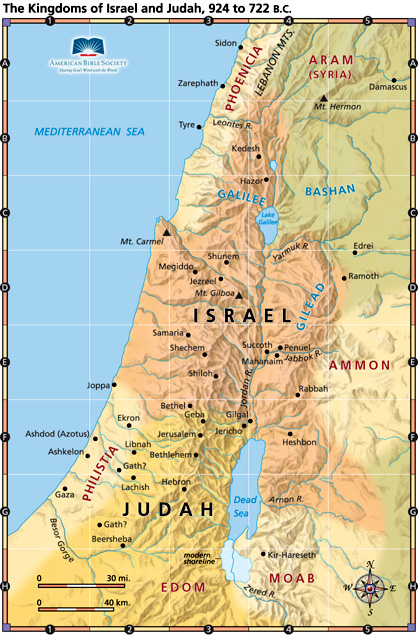 |
Shortly after the death of King Solomon (931 B.C.), the Jewish nation splits in two. Israel in the North and Judah in the South. There are two stories here.
The first one occurs around 887 B.C. and it involves Asa (king of Judah) and Baasha (king of Israel) who are having border disputes. Asa was considered a good king. He had removed many idols and outlawed many practices that hindered his people from worshiping the one and only true God. Baasha on the other hand was considered a bad king and a very treacherous one. He had ascended the thrown by murdering the previous king and all of his kids.
The second story takes place about 35 years later, where Asa's son Jehoshaphat is king of Judah and Ahab is king of Israel. These two kings have kids that married each other, so there is this tenuous truce in place.
Jehoshaphat (the "J" is pronounced like a "Ya") was one of the better kings. Though he made a slip in judgment that caused bad consequences, the history books have portrayed him as more good than evil.
You know how parents who are expecting a child create a list of names to consider? Well my contribution included names like Jehoshaphat and Homer. But my wife suddenly got all UN security council-like and exercised her veto powers. There wasn't even a discussion, but just this look of annoyance as she crossed off those two great names. Consequently, none of my sons are called Jehoshaphat or Homer (after the poet and writer of the Iliad and Odyssey).
Ahab on the other hand was a bad apple and did much evil. The start of his down fall probably came when he married the daughter of the King of Tyre. At the time Tyre was the most powerful and wealthiest city states on the Med. Together king Ahab and his queen Jezebel did much to pull their citizens further away from worshiping God and encouraged worship of these Phoenician gods call the Baals.They did this by appointing a ton of prophets of Baal and systematically killing off God's appointed prophets. |
Before Ahab (king of Israel) comes to power, the King of Aram (Syria), swooped down and took a bunch of cities and the Gilead region (called the Golan Heights today) away from Israel. On the map, Lake Galilee feeds the Jordan river; so that region east of the Jordan river was what Ahab had designs to recover. My hunch is that Ahab married Jezebel so he could get his father-in-law to help finance the recovery project. I also think he gave his daughter's hand in marriage to the prince of Judah because he needed peace to the South and the assistance of Judah's troops. I know things have really changed in the last 3000 years, but back then the king of Aram (Syria) was a ruthless dictator (unlike today) and was unlikely to give up power without a fight.
So now that the stage has been set, let's delve into the scriptures and see if you can pick up the multiple slips of judgments these leaders make. There are multiple kings in this story. But pay special attention to the two kings of Judah, who I believed were more good than evil and who loved the LORD. But as lead decision makers they both make the same error. Let's see if you can pick up the errors made 2909 years ago.
Asa’s Last Years
In the thirty-sixth year of Asa’s reign Baasha king of Israel went up against Judah and fortified Ramah to prevent anyone from leaving or entering the territory of Asa king of Judah.
Asa then took the silver and gold out of the treasuries of the Lord’s temple and of his own palace and sent it to Ben-Hadad king of Aram, who was ruling in Damascus. “Let there be a treaty between me and you,” he said, “as there was between my father and your father. See, I am sending you silver and gold. Now break your treaty with Baasha king of Israel so he will withdraw from me.”
Ben-Hadad agreed with King Asa and sent the commanders of his forces against the towns of Israel. They conquered Ijon, Dan, Abel Maim and all the store cities of Naphtali. When Baasha heard this, he stopped building Ramah and abandoned his work. Then King Asa brought all the men of Judah, and they carried away from Ramah the stones and timber Baasha had been using. With them he built up Geba and Mizpah.
Did you catch the error both kings made? Baasha's error is very obvious. He relied on a cease fire treaty with Aram (Syria) so he could continue a civil war with people to his south. But who knew 3000 years ago it wasn't a good idea to put your trust in the leader of Syria? As you can see, everything backfired for Baasha. Syria reneges on the cease fire agreement, Syrian troops enter his territory, he loses people, cities, and territory. As far as his war effort in the South, all the resources that were meant to strengthen his position against his "enemy" are now being used against him. Now he's stuck in the middle with unfriendlies to his north and south.
But what was king Asa's error? It's not obvious. On the surface it looks like he deters and out foxes king Baasha's hostile advances. Some could argue that Asa engaged in the ultimate form of diplomacy, where you are able to gain your objective without the need to fire a single shot. But Asa makes a very serious tactical error here, which then causes bad long term consequences. I dare say that men today who have been placed in leadership roles (i.e. husband, father or business decision maker) and continue to make the same exact error Asa made a few thousand years ago.
Before getting into the exact details of Asa's mistake. Asa's son Jehoshaphat makes the slip in judgment. Both Asa and Jehoshaphat are relatively good godly men. But that trait doesn't make you immune to bad decision making. See if you can spot Jehoshaphat slip in judgment.
2 Chronicles 18
Micaiah Prophesies Against Ahab
Now Jehoshaphat had great wealth and honor, and he allied himself with Ahab by marriage. Some years later he went down to see Ahab in Samaria. Ahab slaughtered many sheep and cattle for him and the people with him and urged him to attack Ramoth Gilead. Ahab king of Israel asked Jehoshaphat king of Judah, “Will you go with me against Ramoth Gilead?”
Jehoshaphat replied, “I am as you are, and my people as your people; we will join you in the war.” But Jehoshaphat also said to the king of Israel, “First seek the counsel of the Lord.”
So the king of Israel brought together the prophets—four hundred men—and asked them, “Shall we go to war against Ramoth Gilead, or shall I not?”
“Go,” they answered, “for God will give it into the king’s hand.”
But Jehoshaphat asked, “Is there no longer a prophet of the Lord here whom we can inquire of?”
The king of Israel answered Jehoshaphat, “There is still one prophet through whom we can inquire of the Lord, but I hate him because he never prophesies anything good about me, but always bad. He is Micaiah son of Imlah.”
“The king should not say such a thing,” Jehoshaphat replied.
So the king of Israel called one of his officials and said, “Bring Micaiah son of Imlah at once.”
Dressed in their royal robes, the king of Israel and Jehoshaphat king of Judah were sitting on their thrones at the threshing floor by the entrance of the gate of Samaria, with all the prophets prophesying before them. Now Zedekiah son of Kenaanah had made iron horns, and he declared, “This is what the Lord says: ‘With these you will gore the Arameans until they are destroyed.’”
All the other prophets were prophesying the same thing. “Attack Ramoth Gilead and be victorious,” they said, “for the Lord will give it into the king’s hand.”
The messenger who had gone to summon Micaiah said to him, “Look, the other prophets without exception are predicting success for the king. Let your word agree with theirs, and speak favorably.”
But Micaiah said, “As surely as the Lord lives, I can tell him only what my God says.”
When he arrived, the king asked him, “Micaiah, shall we go to war against Ramoth Gilead, or shall I not?”
“Attack and be victorious,” he answered, “for they will be given into your hand.”
The king said to him, “How many times must I make you swear to tell me nothing but the truth in the name of the Lord?”
Then Micaiah answered, “I saw all Israel scattered on the hills like sheep without a shepherd, and the Lord said, ‘These people have no master. Let each one go home in peace.’”
The king of Israel said to Jehoshaphat, “Didn’t I tell you that he never prophesies anything good about me, but only bad?”
Micaiah continued, “Therefore hear the word of the Lord: I saw the Lord sitting on his throne with all the multitudes of heaven standing on his right and on his left. And the Lord said, ‘Who will entice Ahab king of Israel into attacking Ramoth Gilead and going to his death there?’
“One suggested this, and another that. Finally, a spirit came forward, stood before the Lord and said, ‘I will entice him.’
“‘By what means?’ the Lord asked.
“‘I will go and be a deceiving spirit in the mouths of all his prophets,’ he said.
“‘You will succeed in enticing him,’ said the Lord. ‘Go and do it.’
“So now the Lord has put a deceiving spirit in the mouths of these prophets of yours. The Lord has decreed disaster for you.”
Then Zedekiah son of Kenaanah went up and slapped Micaiah in the face. “Which way did the spirit from the Lord go when he went from me to speak to you?” he asked.
Micaiah replied, “You will find out on the day you go to hide in an inner room.”
The king of Israel then ordered, “Take Micaiah and send him back to Amon the ruler of the city and to Joash the king’s son, and say, ‘This is what the king says: Put this fellow in prison and give him nothing but bread and water until I return safely.’”
Micaiah declared, “If you ever return safely, the Lord has not spoken through me.” Then he added, “Mark my words, all you people!”
Ahab Killed at Ramoth Gilead
So the king of Israel and Jehoshaphat king of Judah went up to Ramoth Gilead. The king of Israel said to Jehoshaphat, “I will enter the battle in disguise, but you wear your royal robes.” So the king of Israel disguised himself and went into battle.
Now the king of Aram had ordered his chariot commanders, “Do not fight with anyone, small or great, except the king of Israel.” When the chariot commanders saw Jehoshaphat, they thought, “This is the king of Israel.” So they turned to attack him, but Jehoshaphat cried out, and the Lord helped him. God drew them away from him, for when the chariot commanders saw that he was not the king of Israel, they stopped pursuing him.
But someone drew his bow at random and hit the king of Israel between the breastplate and the scale armor. The king told the chariot driver, “Wheel around and get me out of the fighting. I’ve been wounded.” All day long the battle raged, and the king of Israel propped himself up in his chariot facing the Arameans until evening. Then at sunset he died.
Just like the former leader of Israel, king Ahab's error is pretty obvious. His own ambitions trounces God's voice that comes from a single prophet of God. But who knew that you couldn't trust the voices of 400 prophets that you and your wife had appointed to their position? Ahab's ambitions blinds him and he pays for it with his life, his wife's life, and soon the entire nation. On the other hand Jehoshaphat's mistake, like his dad's, isn't obvious.
They made such a stupid mistake that both are clueless to what they did wrong; So God has to send someone to tell them. Next week, lets investigate their serious slip in judgment ........and Syria.
sources:
Chronology of the Kings of Israel and Judah 1020 - 587 BCE.
John, and Philip R. Davies. The Old Testament World. Englewood Cliffs, N.J.: Prentice-Hall, 1982
Back to the top