Greetings!
A few shipments arrived
this week. If you log
into your account at www.toywonders.com, before clicking on any of the links
below, approved wholesale accounts will see wholesale pricing.
Forgot
your password?
Having
trouble viewing this page?
Missed
a previous week's newsletter?
DIECAST Collectible
Model Cars And More
| Item# |
Description |
Stock
Status |
| GU17623 |
Guiloy - Indian Chief 348 Motorcycle (1948, 1:10, Black) GU17623 |
New |
| 11006BK |
Motor City - Ford Model A Pickup (1931,1:18 Scale Model Diecast, Black) 11006 |
Restock |
| 184790 |
Norev Racing - Peugeot 908 Le Mans #8 Race Car (2007,1:18 Scale Model Diecast, Black/ White) 184790 |
New |
| 187501 |
Norev Show Room - Porsche 911 Turbo Cabriolet Convertible (2007,1:18 Scale Model Diecast, Silver) 187501 |
New |
| 187502 |
Norev Show Room - Porsche 911 GT2 Hard Top (2007,1:18 Scale Model Diecast, Red) 187502 |
New |
| 187518 |
Norev Racing - Porsche RS Spyder #20 Race Car (2007,1:18 Scale Model Diecast, Blue/ White) 187518 |
New |
| 187519 |
Norev Racing - Porsche RS Spyder #31 Le Mans Series - Team Essex (2008,1:18 Scale Model Diecast, Blue) 187519 |
New |
| 187534 |
Norev Show Room - Porsche Cayenne Turbo SUV w/ Sunroof (1:18, Grey) 187534 |
New |
| 187901 |
Norev - Alfa Spider Convertible (1:18, Red) 187901 |
New |
| 188340 |
Norev - Audi R10 Le Mans #8 Race Car (2006,1:18 Scale Model Diecast, Silver) 188340 |
New |
| 41005 |
Motor City - Ford Model A Pickup (1931,1:18 Scale Model Diecast, Weathered Rust) 41005 |
Restock |
| 44001R |
Motor City - Ford Model A Firemen Tudor (1931,1:18 Scale Model Diecast, Red) 44001 |
Restock |
| MO50041SV |
Mondo Motors - Maserati Gran Turismo Hard Top (1:18, Silver) MO50041 |
Restock |
| 11111 |
Motor City - Camper (1:18, Stainless Steel) 11111 |
Restock |
| GU67505 |
Guiloy - Ferrari 250 GTO #24 Le Mans 24 Hours (1964,1:18 Scale Model Diecast, Red) GU67505 |
Restock |
| GU67508 |
Guiloy - McLAREN F1 GTR "West FM" Le Mans 24 Hours (1995,1:18 Scale Model Diecast, White) GU67508 |
Restock |
| GU67511 |
Guiloy - Ferrari 250 GTO #26 Le Mans 24 Hours (1964,1:18 Scale Model Diecast, Red) GU67511 |
Restock |
| 20001BN |
Motor City - Ford Model A Roadster Convertible (1931,1:18 Scale Model Diecast, Stone Brown) 20001 |
New |
| 72001YL |
Motor City - Chevy Woody Wagon w/ Surfboard (1939,1:18 Scale Model Diecast, Italian Cream) 72001 |
New |
| 5015D |
Kinsmart - Dodge Caravan SUV (1:32, Asstd.) 5015D |
Restock |
| 5015DW |
Kinsmart - Dodge Caravan SUV (1:32, White) 5015DW |
New |
| 5028DR |
Kinsmart - Volkswagen New Beetle w/ Soccer (1:32, Asstd.) 5028DR |
New |
| 5057DP |
Kinsmart - Volkswagen Classical Beetle Police (1967, 1:32) 5057DP |
Restock |
| 5092D |
Kinsmart - Ford GT (1:36, Asstd.) 5092D |
Restock |
| 5095D |
Kinsmart - Mercedes Benz SLK-Class Hard Top (1:32, Asstd.) 5095D |
Restock |
| 5106D |
Kinsmart - Turbo Buggy (5", Asstd.) 5106D |
Restock |
| 5302D |
Kinsmart - Porsche Boxster S Convertible (1:34, Asstd.) 5302D |
Restock |
| 5305D |
Kinsmart - Mitsubishi Eclipse Spyder Convertible (2007, 1:36, Asstd.) 5305D |
Restock |
| 5306DD |
Kinsmart - Volvo C70 Convertible (1:36, Asstd.) 5306DD |
Restock |
| 5310D |
Kinsmart - Shelby GT500 Hard Top (2007, 1:38, Asstd.) 5310D |
Restock |
| 5313D |
Kinsmart - Chevrolet Bel Air Hard Top (1957, 1:40, Asstd.) 5313D |
Restock |
| 5315D |
Kinsmart - Audi R8 Hard Top (1:36, Asstd.) 5315D |
Restock |
| 5316D |
Kinsmart - Chevy Corvette Hard Top (1957, 1:34, Asstd.) 5316D |
Restock |
| 5317D |
Kinsmart - Lamborghini Murcielago LP640 Hard Top (1:36, Asstd.) 5317D |
Restock |
| 5318/69D |
Kinsmart - BMW Z4 Coupe Hard Top and Convertible (1:32, Asstd.) 5318/69D |
Restock |
| 5319D |
Kinsmart - Ford Thunderbird Hard Top (1955,1:36, Asstd.) 5319D |
Restock |
| 5320D |
Kinsmart - Chevy Corvette C6 Z06 Hard Top (1957, 1:34, Asstd.) 5320D |
Restock |
| 5321D |
Kinsmart - Jaguar XK Coupe Hard Top (1:38, Asstd.) 5321D |
Restock |
| 5322D |
Kinsmart - Shelby Cobra 427 S/C Convertible (1965, 1:32, Asstd.) 5322D |
Restock |
| 5327/42D |
Kinsmart - Ford Crown Victoria Police Interceptor (1:42, Asstd.) 5327/42D |
New |
| 649300 |
Norev - General Motors Futurliner (1:64, Red/ White) 649300 |
New |
Please do not reply to this email address..
Any questions or comments, please email us at [email protected]
To unsubscribe to this newsletter, send an email to [email protected] and put the word 'unsubscribe' on the subject line.
Thank you
Lu Su
Toy Wonders, Inc.
www.toywonders.com
201-229-1700

God and the Art of Toy and Diecast Marketing
God Revealed through Prophecy (the background)
By Lu Su
Whenever you set out on a journey, you need to start with a basic set of beliefs that you deem true. If you don't, you won't even be able to begin your journey. In the scientific world, scientists do the same. They start out by accepting things (without proof) they deem to be true and call these beliefs axioms. For example, when scientists want to launch a piece of technology from Earth to Mars, they make the assumption that gravity behaves the same way here on this side of the solar system as it does on the other side of the solar system. So your starting point, and particular the set of beliefs you deem true, is vital for a successful journey.
Many of us were around when the late great Carl Sagan (US astronomer 1934 - 1996) launched us on his journey called COSMOS. The Public Broadcasting Service (PBS) aired this TV series in 1980 and this show continues to be one of the most widely watched PBS series in the world. Carl in the very first episode tells us where he is coming from; Carl defines his axiom.
"The Cosmos is all that there is or ever was or ever will be."
The Cosmos is all that there is. The Cosmos is all that ever was. The Cosmos is all that ever will be. Is this true? This statement excludes the possibility of a Creator. Although Carl states his axiom very poetically, another way of stating Carl's axiom is "In the Beginning, ......the Cosmos".
Although I am not in agreement with Carl's stating point, I do like another quote he gave us. "Absence of evidence is not evidence of absence." -Carl Sagan.
My axiom is that God exists. Furthermore, God gives us evidence that he exists in multiple ways. One way God reveals himself to us is through fulfilled prophecy. Only a being whom exists outside of time and space could consistently and without error predict the future. There are many; but let's look at just one prophecy that is found in the older portion of the Bible. It's found in the book called Ezekiel. In this book the prophecy is given; but the fulfillment of this prophecy is not found in the Bible -but in our history books. The prophecy is about this ancient city called Tyre. But before launching into the prophecy, you would benefit by having some background knowledge of the historical significance of this ancient city.
Tyre was once a grand city. And it was the most important city to a people called the Phoenicians. Tyre was located in what is now modern day Lebanon. And because the Phoenicians were renowned ship builders and sailors, Tyre was strategically located next to the Mediterranean sea and the mouth of a major river.
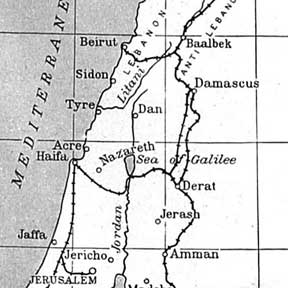
The Greek historian Herodotus, records that Tyre was founded in the 28th century B.C. Herodotus, the "Father of History", had personally visited Tyre during the 5th century B.C. and described the famous Temple of Melkart. The priest of the city-god told him that the temple was built 2300 years previously. So if the priest and Herodotus had their facts straight, this puts the founding of Tyre all the way back to 2750 B.C. Given that it is now 2009 A.D., we can say that this city came into being about 5000 years ago.
The Greek civilization, which had greatly shaped Western culture, was greatly influenced by the inhabitants of Tyre. The introduction of the alphabet into Greece was attributed to Cadmus of Tyre. And it was Cadmus' sister Europa, whom the continent 'Europe' is named after. That would be kind of cool to get a continent named after you. So if future generations would like to name a continent after me, allow me to voice my opposition. "Lu" would NOT work well. First of all "Lu" is only one syllable, which goes against the two or more syllable fashion trend. And secondly, probably 90% of the English speaking population think the alternate meaning for 'Lu' is "toilet".
With the possible exception of Egypt, Tyre was the wealthiest city in the entire Mediterranean area. One reason why was its proximity to a rich natural resource called the "Cedars of Lebanon". Kings far and near requested the wood for their religious and civil constructs. Probably the most famous was the use of cedar in the construction of the Temple of Israel that King Solomon built. Also, according to the Talmud, Jews once burned Lebanese cedar wood on the Mount of Olives to welcome in the new year (I bet this smelled much better than that glittering ball ritual we do in New York City). And like how tri-colored shag carpeting was an in-thing for us Americans at one time; back then, lining your home's walls with this cedar was the rage. This choice wood was sought after by many civilizations: Romans, Greeks, Persians, Assyrians, Babylonians and Egyptians. This wood was of such great importance and significance, even today it is found on the Lebanese flag.

But there is more to it than just being near a natural resource. Because of the Phoenicians sailing abilities, wealth was primarily generated through trade and believe it or not, the harvesting the Mediterranean sea snail. The sea snail allowed them to produce highly-coveted purple dye. This color was rare and difficult to produce, a factor in its adoption by rulers as a color of royalty. As late as the reign of Roman emperor Diocletian (284-305 AD), two pounds of purple dye sold for over six pounds of gold. So now you know how the color purple got associated with royalty (and why kings back then smelled a bit snailly). Other Phoenician cities also traded in the prized dye, but Tyre was the center of production for this rare commodity.
Because of its numerous sailing vessels for both for trade and for its navy, Tyre became known as the "Queen of the Seas" and brought commerce throughout the entire Mediterranean region. In order to increase their trading leverage, many Phoenician colonies sprung up in other cultures. The Phoenicians had trading contacts in Egypt and Greece; and established colonies as far west as Spain. And the colony in Spain even established trade routes all the way to Great Britain! The most famous and successful Phoenician colonies was Kart-Hadasht (which means "New Town"). It would eventually be known as Carthage. I need to throw in this next sentence because us American's geography is so poor. Carthage is located in modern day Tunisia which is a country on the continent of Africa that is also on the Mediterranean -almost directly southwest of Italy.
So is that all you need to become a wealthy city? Be near natural resources, engage in trade, build ships to move your product, build a great navy to protect your ships, and harvest the sea snail? Another reason why Tyre became the so wealthy and asserted so much influence in the region was because for over 2000 years since its founding, Tyre had never been ransacked by invaders. Apparently, accumulating wealth is easier to accomplish when you don't have a sword sticking out of you chest; or if your enemies aren't hauling your family members and your family heirlooms away.
Up until the time of 585 B.C. the city of Tyre sat on the mainland and had never been conquered. You see before Tyre became a city, it was first a massive fortress. Walls upon walls to protect its denizens. Towers and spires so high that ground archers had difficulty in reaching them. There are some historical accounts that say that the walls were so tall and thick that four chariots riding side by side could traverse the circumference of the walled city. The thickness of their walls was probably overkill. Students of history know that it was not until Alexander the Great who used an invention called the tension catapult, were people able to go through walls. Before that, if you wanted to get over a wall, you either went under it or over it. And before 585 B.C., nobody had been successful in breaching the walls of Tyre.
Advanced readers who want to know more about the city and its inhabitants, read the biblical account describing the city of Tyre in all its grandeur.
So now that you have some background knowledge of Tyre, next week lets look at the prophecy and to see what happened to the city. And if you don't like prophecy, just like many scientists do, you can turn a blind eye away from it. But all will not be lost. Look on the positive side; look at all the new trivia you just learned (i.e. Tyre, Lebanese flag, Europa, cedar wood, Kart-Hadasht). You can now with confidence walk into to Cheers or any tavern and go toe to toe with any Cliff Clavin on "little known facts"..... And don't forget about those Mediterranean sea snails.


