Greetings!
A few shipments arrived
this week. If you log
into your account at www.toywonders.com, before clicking on any of the links
below, approved wholesale accounts will see wholesale pricing.
Forgot
your password?
Having
trouble viewing this page?
Missed
a previous week's newsletter?
DIECAST Collectible
Model Cars And More
Toys
To remove yourself
from our mailing list, please log into your account at Toy Wonders, modify personal
information and uncheck the option Keep me informed about new products and offerings.
Or reply to this email and say unsubscribe.
Thank you
Lu
Toy Wonders, Inc.
www.toywonders.com
201-229-1700

God and the Art of Toy and Diecast Model Car Marketing
Finding God with Numbers (part 2 of 2)
By Lu Su
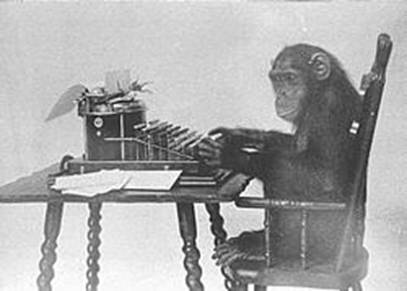
This week I would like to look into the infinite monkey theorem. This theorem simply states that a monkey keying at random on a typewriter for an infinite amount of time will almost surely type a particular chosen text, such as the complete work of Willam Shakespeare’s Hamlet.
So the question I would like to pose is which is more probable? Hamlet appearing on the monkey’s typewriter? Or life coming into existence (with no intelligent designer) and eventually “evolving” to a living and breathing human being?
Right off, I think most of us realize that there certainly is a chance a monkey could accidently type out Hamlet –although a very small one. But since the odds are NOT zero, it is very conceivable that this could happen –especially if given an infinite amount of time. Somebody’s has to eventually win the Mega Million State Lottery and get the Power Ball right?
The calculation of a monkey typing out Hamlet is fairly straight forward. Hamlet starts with the words “Enter Barnardo”. Let’s cheat a little bit and say that this particular typewriter that the monkey is using, only has 26 letters. So this typewriter has no function keys, no numbers, no punctionation keys and no symbols (And certainly no Ctrl Alt Delete key either). Just a stripped down version of a typewriter with only 26 letters on it (i.e. from letter A to Z). Also since there is no space or caps lock key, the monkey neither has to worry about spacing between words nor capitalization of names or the first word in a sentence. That seems like a pretty generous offer.
The chance of the money getting the first letter correctly is 1 out of 26 (also denoted as 1/26). There are 26 different possible letters, only one of them is correct. Now the chances of the monkey typing the 2nd letter correctly is also 1/26, because the second key is totally independent of the first key stroke. To calculate the odds that the monkey gets the first two letters correct, would be to simply multiply these numbers in determining the probability that the monkey types letter E first and then a N second. So the probablilty of getting the first two letters correct is 1/26 x 1/26 = 1/676. So the chances that the monkey would type our the first word “Enter” correctly is 1/26 x 1/26 x 1/26 x 1/26 x 1/26. This get’s really ackward to write, so the easier way to say this is 1/26 to the 5th power. You would write it out as (1/26) 5;
Now for the monkey to type the first 20 letters correctly (ignoring spaces), the probability would be 1/26 to the 20th power or (1/26) 20, which equals 1 in 19,928,148,895,209,409,152,340,197,376 chances. That’s a fairly large number. I know it is a big number because it doesn’t fit on my calculator and the IRS doesn’t provide a space large enough to write such a number in their Gross Income section (We diecast model car distributors should all complain about this to the IRS). Another reason that I know this is a large number is because I don’t even know how to say this number (Ka-Jillion-Billion?). But nevertheless, I know 1 in (26) 20 chance is still not zero, so there still is a chance that the monkey gets the first 20 letters correctly. To put some perspective on this, the chances of a monkey typing out the first 20 character out correctly is roughly equivalent to the probability of buying just 4 lottery tickets and consecuively winning the jackpot 4 times in a row. And I know that event hasn’t occurred because this news would make headlines on every newspaper in the world.(and the person probably thrown in jail for somehow scamming the system). But conceivibly, it could happen right?
As for a real live monkey experiment, in 2003, faculty and students from the University of Plymouth MediaLab Arts course used a grant to study the literary output of real monkeys. They left a computer keyboard in the enclosure of six monkeys in the Paignton Zoo in Devon in England for a month, with a radio link to broadcast the results on a website. One researcher, Mike Phillips, defended the expenditure as being cheaper than reality TV and still "very stimulating and fascinating viewing". Not only did the monkeys produce nothing but five pages consisting largely of the letter “S”, the alpha male kept on bashing the keyboard with a rock, and several monkeys continued by urinate and defecate on the keyboard (I wonder what they did with all the used keyboards after the experiment. Sneak it back into one of their computer labs? Sell it on Ebay at a really good price?) But in the end, nothing close to Hamlet or any of Shakespeare’s other works of art made an appearance (Not even “Enter Monkey”). But that was only for a month’s time. The monkey theorem states an “infinite amount of time”. What about if we simulated this experiment for longer periods of time?
With the power of computers today we can run simulations or programs that we call random letter generators and run them on powerful computers capable of millions of comutations per second. We can even string them together for faster results. This reminds me of that 60 minutes episode (I think) where they interviewed this guy working out of his house and he has like 50 computers and monitors all stacked up one on top of each other. All of them busy sending out email solicitation (spam) at something on the rate of a million emails per minute. The interviewer asked the guy, “Why would you do such a dastardly thing?” His reply was something like if just 1 person out of billion persons responds to the email solicitation, his client(s) makes money and thereby justify paying him for what he does. (And the whole time I was thinking that when this spammer goes to run an errand, we should release those six monkeys into this guys house.) Anyway, back to my point. Dan Oliver of Scottsdale, Arizona, according to an article that was published in The New Yorker ran this computer program simulation that generated strings of text and came up with a result on August 4, 2004: After the group had worked for 42,162,500,000 billion billion years, one of the "monkeys" typed, “VALENTINE. Cease toIdor:eFLP0FRjWK78aXzVOwm)-‘;8.t . . ." The first 19 letters of this sequence can be found in The Two Gentlemen of Verona. Other teams have reproduced 18 characters from Timon of Athens, 17 from Troilus and Cressida, and 16 from Richard II.
Please note that after running this experiment for a time period 42,162,500,000 billion billion years, none of their simulations produced 20 correctly sequenced characters in any chapter of Shakespeare’s Hamlet. Plus we have another issue; it’s related to the age of the universe. The age of the universe is the time elapsed between the Big Bang and the present day. Current observations suggest that the age of the universe is about 13.73 billion years old, with an uncertainty of about 120 million years. So in terms of running the simulation for a time period that is longer than the time period from the big bang to now, is certainly fair (especially when the complexity is being compared to the creation of life). Moreover, we have gone way beyond the amount of time that has elapsed from the big bang to now, so I don’t think arguing that we just haven’t given it enough time is fair. But the actual problem is more complex than (1/26) 20.
Hamlet is composed of approximately 130,000 letters (if you remove all the punctuation and don’t count space as a letter). So the chances of a monkey typing out Hamlet is on the order of (1/26) 130,000
I don’t think man can truly conceive how big (or should I say small?) this number is. We humans don’t multiply by factors of 26 very well, we like to express thing in the power of ten. So the chances of Hamlet making an appearance actually a number close to 1 over 3.4 × (10) 183,946. To put some perspective on how giagantic this number is, for comparison purposes, there are only about 1080 atoms in the observable universe and less than 1018 seconds have elapsed since the Big Bang to now. Even if the observable universe were filled with monkeys typing for all time, their total probability to produce a single instance of Hamlet would still be less than one in 10183,800.
The point I’m trying to make is the chances of a monkey typing out Hamlet is a number so close to zero, you could safely say that it would never happen. Put it this way, I would bet the farm that no monkey is ever going to accidently produce this piece of literature. Now the chances of life coming into being into exisitence is far less likely than a monkey typing out Hamlet.
Many of you have heard some buzz on the Human Genome Project. The human genome is the genome of homo sapiens, which is stored on 24 distinct chromosomes (22 autosomal chromosomes, plus the sex determing X and Y chromosomes, which containing an estimated 20,000–25,000 genes. The entire human genome occupies a total of just over 3 billion DNA base pairs.
Now if my understanding of math is correct, 3 billion (3,000,000,000) is larger than 130,000. But did you realize that our DNA is more complex than 3 billion properly sequenced letters? A DNA base pair contains a piece of coding that the base pair cannot even be expressed with a single letter, but a string of letters is used to represent a base pair.
Now if the random letter generator was unable to produce even 20 correctly sequenced letters out of Hamlet in 42,162,500,000 billion billion monkey years, getting 130,000 properly sequenced letters is NOT going to happen no matter how long your run the simulation. If this statement is true, it is reasonable to say that the 3 billion properly sequenced base pairs coming together randomly is not going to happen either –unless intelligence is involved.
Plus, keep in mind evolution does not provide this generous amount of time as possited in the infinite monkey theorem –an infinite amount of time. Scientists estimate that the universe is less than 14 billion years old and that earth is 4.5 billion years young. Even if the earth was 45,162,500,000 billion billion years old, which all scientists say it is NOT; there has not been even close to the amount of time to randomly produce a Hamlet or the human DNA.
Just a quick side note here-- Even if you were to generate a strand of DNA, that does not mean you now have a living and breathing human being; corpses and mummies also have DNA too. So this would add another layer of complexity to the calculation of life.
From my understanding of numbers, multiplication, and probability, it does not show me that matter plus energy plus time is all the necessary ingredients that you need to make life. Numbers have showed me that it is too improbable that I have concluded that intelligence MUST have entered into this equation.
In conclusion, the infinite monkey theorem is wrong. Hamlet would surely NOT appear. So in that light, I admit that I just don’t have enough faith to believe that life can spring up by itself in the absence of intelligence or a creator. If you want to bet against the odds, then I would argue that your faith is far stronger than mine.


